
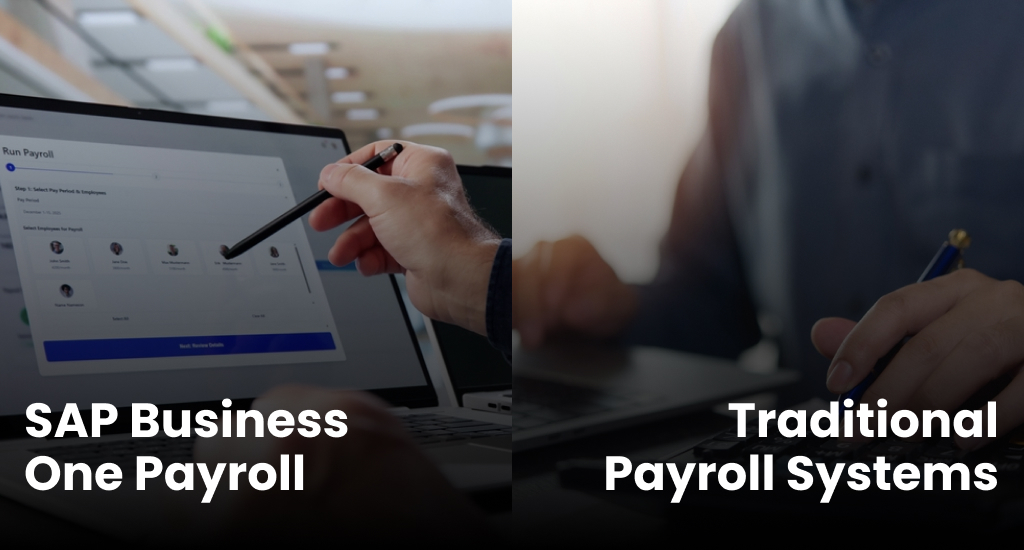
SAP Business One Payroll vs Traditional Payroll Systems
Payroll management is one of the most critical functions in any organization, yet many businesses still rely on outdated processes that slow them down and increase risk. As companies scale, the gap between modern ERP-driven payroll and traditional payroll systems becomes increasingly difficult to ignore. This is where SAP Business One payroll stands out as a strategic solution that combines automation, compliance, and real-time insights into one unified platform.
Let’s compare SAP Business One payroll with traditional payroll systems to help you understand which approach aligns best with your business goals in 2026 and beyond.
Traditional Payroll Systems
Traditional payroll systems are typically manual or semi-automated processes that rely heavily on spreadsheets, standalone software, or outsourced services. While they may work for small teams, they often create inefficiencies as organizations grow.
Common challenges include data duplication, limited reporting capabilities, compliance risks, and a lack of integration with finance or HR systems. These gaps can lead to errors in salary calculations, delayed payments, and poor employee experience.
What is SAP Business One Payroll?
SAP Business One payroll is an integrated payroll management solution within the SAP Business One ERP ecosystem. It automates payroll processing, ensures regulatory compliance, and seamlessly integrates payroll data with accounting, HR, and business operations.
By centralizing data and automating calculations, it reduces manual intervention and provides accurate, real-time insights that decision makers can rely on.
Key Differences Between SAP Business One Payroll and Traditional Systems
1. Automation and Efficiency
SAP Business One payroll automates complex calculations, such as taxes, deductions, and benefits. On the other hand, traditional systems often require manual input, resulting in a higher risk of human error and being time-consuming.
2. Compliance and Accuracy
Staying compliant with changing tax regulations is challenging. SAP Business One payroll is designed to adapt to local and international compliance requirements; on the contrary, traditional systems depend on manual updates that can easily be overlooked.
3. Integration with Business Processes
Unlike traditional payroll systems, SAP Business One payroll integrates seamlessly with finance, inventory, and HR modules. This integration ensures consistent data flow and eliminates the need for duplicate entries.
4. Reporting and Insight
The importance of data-driven decisions is critical in modern business. SAP Business One payroll provides advanced analytics and customizable reports, while traditional systems offer limited visibility into payroll data.
5. Scalability and Growth
As businesses expand, payroll complexity increases. SAP Business One payroll scales effortlessly with your organization, whereas traditional systems often struggle to keep up with growing demands.
Why Businesses Are Switching to SAP Business One Payroll?
Organizations are increasingly adopting SAP Business One payroll to gain a competitive edge. The ability to automate repetitive tasks, reduce errors, and ensure compliance makes it a valuable investment. And businesses benefit from improved employee satisfaction due to timely and accurate salary processing. In a landscape where talent retention is crucial, this advantage cannot be ignored.
Choose the Right Payroll Solution
Selecting between SAP Business One payroll and traditional payroll systems depends on your business size, growth plans, and operational complexity. However, for companies aiming for digital transformation, automation, and scalability, SAP Business One payroll offers a clear advantage.
Future Trends in Payroll Management
Payroll technology continues to evolve with artificial intelligence, cloud computing, and real-time analytics shaping the future. SAP Business One payroll is positioned to leverage these innovations, offering predictive insights and smarter automation.
In contrast, traditional payroll systems often lag, making it difficult for businesses to stay competitive in a fast-changing environment.
Cost Considerations and ROI
While the initial investment in SAP Business One payroll may be higher than traditional systems, the long-term return on investment is significant. Reduced manual labor, fewer errors, and improved efficiency translate into cost savings over time. Also, integrated systems minimize the need for multiple software tools, further reducing operational expenses.
Security and Data Protection
Data security is a growing concern for businesses worldwide. SAP Business One payroll incorporates robust security protocols, ensuring sensitive employee data is protected. Traditional payroll systems, especially those relying on manual processes, are more vulnerable to data breaches and unauthorized access.
Ultimately, choosing SAP Business One payroll empowers organizations to operate with precision, agility, and confidence. It supports strategic decision-making, enhances operational transparency, and prepares businesses for future challenges. Companies that continue with traditional payroll systems risk falling behind in efficiency and compliance. Adopting a modern ERP-driven payroll solution is no longer optional; it is essential for sustained success in today’s global competitive market.
Wrap Up
The shift from traditional payroll systems to SAP Business One payroll is not just a technological upgrade; it is a strategic move toward efficiency and growth. Businesses that invest in modern payroll solutions are better equipped to handle compliance, reduce costs, and make informed decisions.
If you are ready to streamline your payroll operations and future-proof your business, contact us and explore our SAP Business One payroll solutions today.