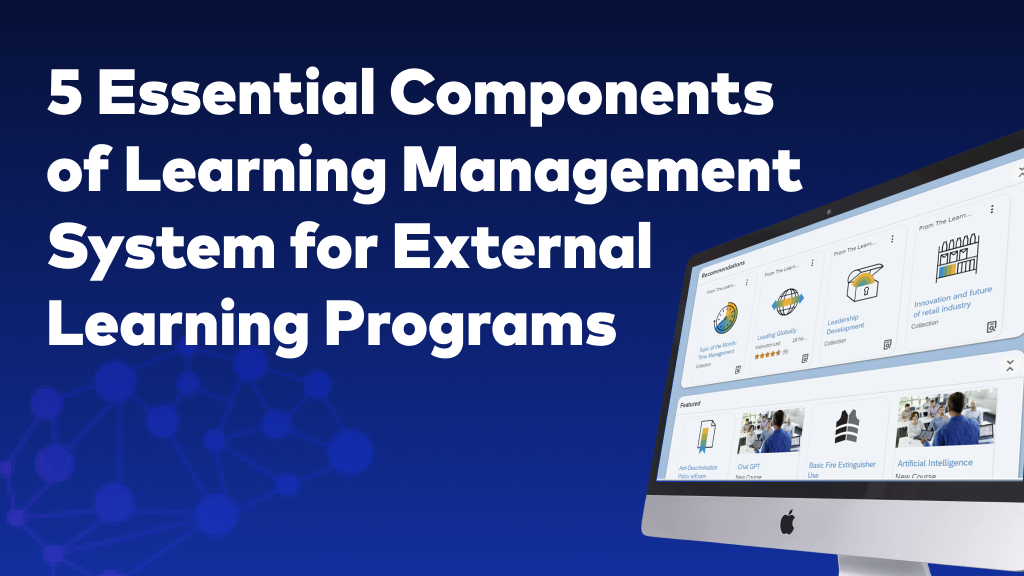
Essential Components of a Modern Learning Management System
It is common practice among organizations to invest in skilled partners, great products, and loyal customers. But when training is outdated, clunky, or scattered with a lot of tools, people find it boring, and engagement declines even before the lesson begins. And this is the crucial point which requires the right components for a learning management system for external learning.
Such external learning programs, which are specifically designed for partners, customers, or resellers, carry a totally distinct set of needs as compared to internal worker training. They must be seamless, require more flexibility, and systems that scale without breaking down.
Fortunately, we have compiled five essential components that represent a high-performing LMS for external learning programs.
1. Scalable Content Management and Delivery
Every high quality and effective LMS is able to organize, create, and deliver learning content in numerous formats. So it is crucial to understand that most of the time external learners have diverse backgrounds, and they are coming from multiple industries, due to which they have different learning spectrums. And only a scalable LMS can cater to this requirement efficiently.
An interactive content management system enables users to upload PDFs, videos, assessments, and interactive modules from a single, centralized location. It also supports content discovery, so learners can find exactly what they need without having to complete an entire course. For instance, if a person is troubleshooting a product feature, they should be able to search for that specific topic rather than wading through hours of unrelated material.
In this highly tech driven world, cloud-based services play a significant role and ensure consistent and updated content delivery. Also, people nowadays have more screen time, and more than 70% of learners prefer mobiles for learning. So, a mobile-first approach is inevitable for the latest LMS.
Thus, the ability to update individual content pieces without revamping whole courses is highly important. Products evolve, and training programs must keep pace without undue disruptions or delays.
2. Flexible User Management and Access Control
External learners do not belong to a single organization or group and could be customers, brand partners, resellers, and affiliates. This diversity makes the learning requirements more distinct and precise. At this point, a scalable learning management system comes into play, as it automates and manages every requirement seamlessly.
Some of the key features of most systems include role-based permissions, SSO, automated enrollment, and self-registration options. Particularly for client training programs where there are high chances of creating duplicate usernames or passwords, Single Sign-On (SSO) integration ensures seamless onboarding without any overwhelming experiences that improve learning completion rates.
A new customer onboarding to a platform should not see the same content as an advanced partner preparing for a certification exam. Personalized paths are more engaging and produce more robust learning outcomes across the board.
3. Assessment Tools and Certification Tracking
It is significant to understand whether external users find their learning experience worthwhile or not, and that could be gauged via assessment tools. That is why a robust LMS must have advanced assessment tools. For external programs, simple quiz scores do not provide a clear picture. Such tools must be designed to verify practical knowledge and assess skills. Certifications issued after such interactive assessment not only improve external learners’ career paths but make the organization more market-credible.
Scenario-based exercises, quizzes, and formal exams provide learners structured ways to show their knowledge. Certification management assures that credentials are issued, tracked, and renewed on schedule, which is particularly essential in regulated industries such as technology, healthcare, and finance.
4. Advanced Reporting and Analytics
When you run an external learning program without data, it is essentially running it on assumptions. And we know assumptions will not secure any data! That is why an advanced LMS comes with automated analytics and reporting, making it a strategic asset for businesses rather than solely a content delivery tool.
Advanced LMS always have highly functional dashboards that allow users to evaluate training or course progress via assessment scores, engagement metrics, and completion rates. The advanced analytics and reporting system allows managers to understand the lagging and success rates of the training. With these analytics, managers can improve parts that require improvement without manual hassle.
Another feature of these LMS is customizable reports, which allow program managers to create easy to understand visual reports about the performance of specific content types or specific cohorts over different instances. If a respective module has a high dropout rate, the data highlights the issue quickly so teams can investigate and improve. Also, real-time insights enable timely intervention when learners fall behind, as it is the most important aspect in strict compliance programs.
5. Seamless Integration and Security
It is a fact that any LMS that operates in isolation creates more issues than it solves. That is why efficient external learning platforms seamlessly connect with any institution’s existing tech stack. These integrations save time by reducing human data entry in systems and smoothly fetch data from video conferencing platforms, HR software, CRM systems, and e-commerce tools, and allowing data flow across systems.
Some of the vital functions, such as partner revenue reporting, certification updates, and customer onboarding, can be improved by API-based integrations that automate all these operations. API-integration is also beneficial for organizations that monetize their features, like their built-in e-commerce tools, training, subscriptions, or other packages.
When it comes to data privacy and security, many organizations just follow superficial methods, but luckily, the latest LMS comes with GDPR and HIPAA compliance, offers data encryption and secure authentication, and protects learners and organizations with reliable backup systems.
Choosing the Right LMS for External Learning Goals
The right components of a learning management system for external learning go far beyond technical checkboxes. They determine how well customers adopt a product, how confidently partners represent a brand, and how effectively an extended network grows.
SipSap helps organizations build external learning programs that deliver real results. Are you ready to get a customized external LMS? Let’s talk!
- By admin